TNS Vanguard
House von Hjertstedt · First-generation dreadnought
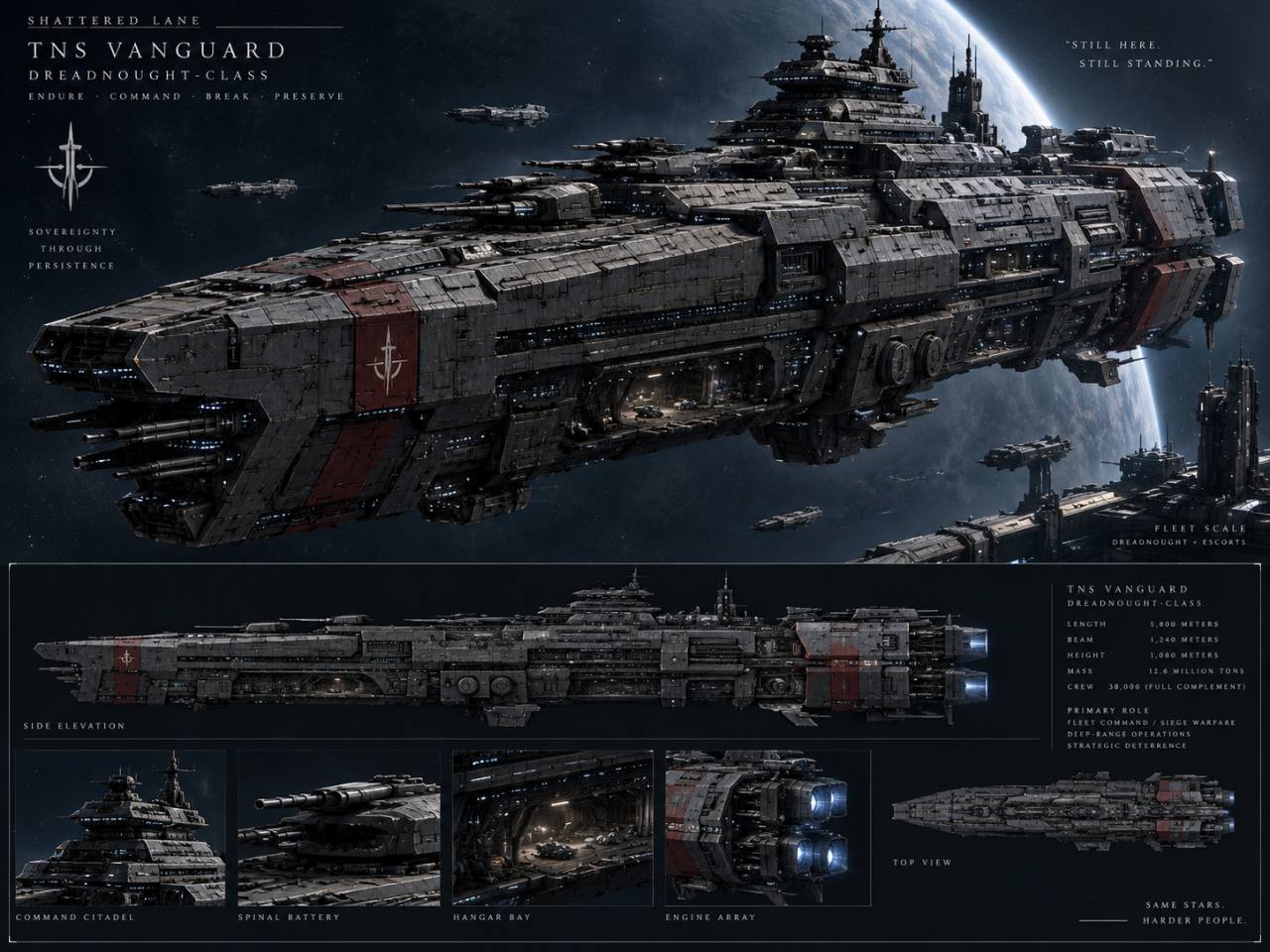
Download reference sheet (PDF)
Canon at a glance
- Archive category
- ships
- Affiliation
- House von Hjertstedt
- Vessel
- TNS Vanguard
- Type
- First-generation space dreadnought
- Length
- 5,800 meters
- Beam
- 1,240 meters
- Height
- 1,080 meters
- Mass
- 12.6 million tons
- Crew
- 38,000 at full complement
- Primary roles
- Fleet command; siege warfare; deep-range operations; strategic deterrence
Overview
One of the first Hjertstedt dreadnoughts: a 5,800-meter fleet-command and siege vessel built to endure, break the line and preserve the fleet.
One of the first
TNS Vanguard belongs to the first generation of House von Hjertstedt dreadnoughts, built when the House needed a fleet that could remain on station through a long campaign. Its task was to give scattered escorts a protected center: somewhere to receive orders, recover small craft and regroup when a defended approach could not be forced in a single assault.
A fortress that could travel
Vanguard carries the priorities of that early era in its silhouette. A long, heavily plated bow leads into a deep armored hull, with tiered gun positions and a stepped command citadel above the dorsal spine. Recessed service spaces and hangar openings break up the flanks. Broad crimson armor zones, worn cold steel and blue-white engines make the ship unmistakable even before its name can be read.
Ship particulars
The supplied reference sheet records a length of 5,800 meters, a beam of 1,240 meters and a height of 1,080 meters. Listed mass is 12.6 million tons, with a full crew complement of 38,000. Its primary roles are fleet command, siege warfare, deep-range operations and strategic deterrence.
Endure. Command. Break. Preserve.
The four words associated with Vanguard describe a sequence of responsibilities. Endure the opening exchange. Keep the fleet under coherent command. Break the position preventing passage. Preserve the ships and people whose survival makes victory worthwhile. Its heavy batteries make it a siege vessel; its command facilities make it the place from which that siege can be controlled.
How Vanguard fights
Vanguard advances with an escort screen, using its heavy forward and dorsal batteries to pressure fortified approaches and enemy capital ships. Lighter vessels cover the directions its main armament cannot answer quickly. Its hangars support liaison, recovery and local small-craft operations while the dreadnought maintains the fleet command picture. Deep-range endurance gives it time to hold a position, but does not remove the need for ammunition, maintenance and supply ships.
The cost of staying
An early dreadnought is a formidable commitment of people and material. Vanguard cannot redeploy as readily as its escorts, and a damaged engine section or interrupted supply line can constrain an entire operation. Its tall command citadel and immense hull are easy to locate. Armor and compartmentalization buy time for damage-control crews; they do not make the ship immune to concentrated fire.
Still here. Still standing.
Vanguard became a symbol of the House commitment to remain when withdrawal would abandon those behind the line. The ship is remembered as one of the foundations of Hjertstedt dreadnought service, rather than the sole origin of it. The words carried on its reference sheet capture that reputation: Still here. Still standing. Its enduring lesson is that a fleet must be able to survive the battle it wins.
Connected entries
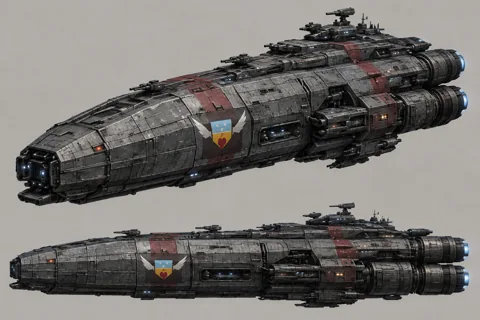 House von Hjertstedt
A sovereign mercenary House whose fleets protect a hidden civilization. Its power rests on conduct, civilian protection and the industrial depth of Vintergard.